 Add to Chrome
 Add to Firefox
 Add to Edge
Fast Multichannel NMF with Block-Diagonal Spatial Covariance Matrices for Efficient Blind Source Separation Using Distributed Microphone Arrays
May 19, 2026
Distributed microphone arrays composed of multiple subarrays enable blind source separation over a wide spatial area. Directly applying fast multichannel nonnegative matrix factorization (FastMNMF) to all subarrays can exploit observations from all subarrays, but it requires repeated inversions of large matrices spanning all microphones, causing the computational cost to increase rapidly as the number of microphones grows. In contrast, applying FastMNMF to one subarray reduces the matrix size but cannot exploit observations from other subarrays. We propose distributed FastMNMF, which imposes a block-diagonal structure on the source spatial covariance matrices, so that matrix inversions are performed within subarrays. The NMF-based source spectrogram model is shared across subarrays, allowing the method to aggregate source activity information while discarding inter-subarray covariance. In synchronized, noiseless simulations with fixed room and array/source geometry, the method required less computation time than conventional FastMNMF using all subarrays, achieved a higher average source-to-distortion ratio than conventional FastMNMF using one subarray, and was applicable in the tested five-source condition, where each four-microphone subarray was locally underdetermined.

Kinetic-Optimal Scheduling with Moment Correction for Metric-Induced Discrete Flow Matching in Zero-Shot Text-to-Speech
May 10, 2026Metric-induced discrete flow matching (MI-DFM) exploits token-latent geometry for discrete generation, but its practical use is limited by two issues: heuristic schedulers requiring hyperparameter search, and finite-step path-tracking error from its first-order continuous-time Markov chain (CTMC) solver. We address both issues. First, we derive a kinetic-optimal scheduler for prescribed scalar-parameterized probability paths, and instantiate it for MI-DFM as a training-free numerical schedule that traverses the path at constant Fisher-Rao speed. Second, we introduce a finite-step moment correction that adjusts the jump probability while preserving the CTMC jump destination distribution. We validate the resulting method, GibbsTTS, on codec-based zero-shot text-to-speech (TTS). Under controlled comparisons with a unified architecture and large-scale dataset, GibbsTTS achieves the best objective naturalness and is preferred in subjective evaluations over masked discrete generative baselines. Additionally, in comparison with the evaluated state-of-the-art TTS systems, GibbsTTS shows strong speaker similarity, achieving the highest similarity on three of four test sets and ranking second on the fourth. Project page: https://ydqmkkx.github.io/GibbsTTSProject
DialogueSidon: Recovering Full-Duplex Dialogue Tracks from In-the-Wild Dialogue Audio
Apr 13, 2026Full-duplex dialogue audio, in which each speaker is recorded on a separate track, is an important resource for spoken dialogue research, but is difficult to collect at scale. Most in-the-wild two-speaker dialogue is available only as degraded monaural mixtures, making it unsuitable for systems requiring clean speaker-wise signals. We propose DialogueSidon, a model for joint restoration and separation of degraded monaural two-speaker dialogue audio. DialogueSidon combines a variational autoencoder (VAE) operates on the speech self-supervised learning (SSL) model feature, which compresses SSL model features into a compact latent space, with a diffusion-based latent predictor that recovers speaker-wise latent representations from the degraded mixture. Experiments on English, multilingual, and in-the-wild dialogue datasets show that DialogueSidon substantially improves intelligibility and separation quality over a baseline, while also achieving much faster inference.
Geneses: Unified Generative Speech Enhancement and Separation
Jan 26, 2026Real-world audio recordings often contain multiple speakers and various degradations, which limit both the quantity and quality of speech data available for building state-of-the-art speech processing models. Although end-to-end approaches that concatenate speech enhancement (SE) and speech separation (SS) to obtain a clean speech signal for each speaker are promising, conventional SE-SS methods suffer from complex degradations beyond additive noise. To this end, we propose \textbf{Geneses}, a generative framework to achieve unified, high-quality SE--SS. Our Geneses leverages latent flow matching to estimate each speaker's clean speech features using multi-modal diffusion Transformer conditioned on self-supervised learning representation from noisy mixture. We conduct experimental evaluation using two-speaker mixtures from LibriTTS-R under two conditions: additive-noise-only and complex degradations. The results demonstrate that Geneses significantly outperforms a conventional mask-based SE--SS method across various objective metrics with high robustness against complex degradations. Audio samples are available in our demo page.
Emotional Text-To-Speech Based on Mutual-Information-Guided Emotion-Timbre Disentanglement
Oct 02, 2025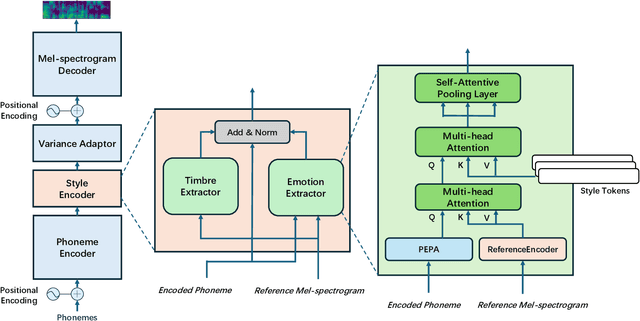
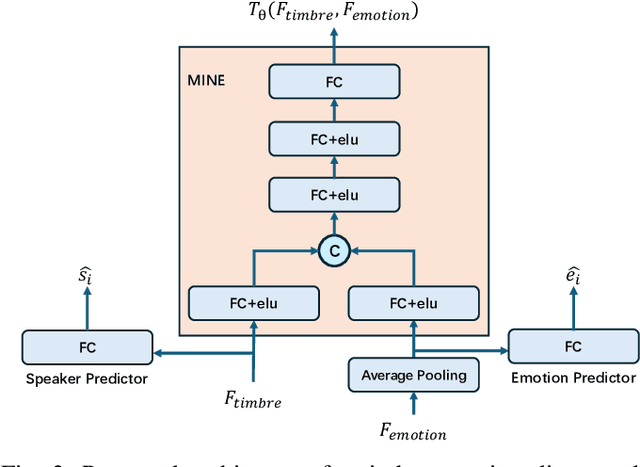
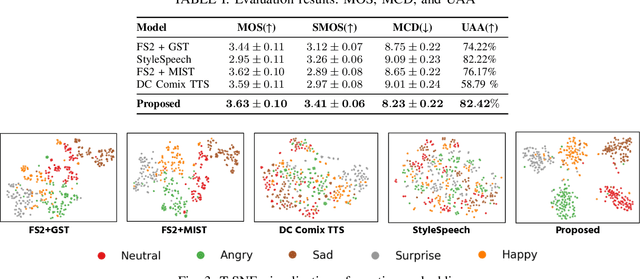
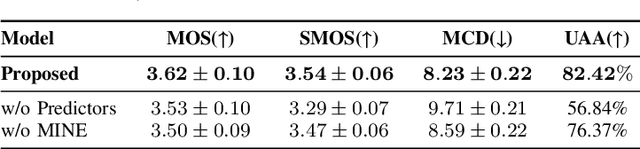
Current emotional Text-To-Speech (TTS) and style transfer methods rely on reference encoders to control global style or emotion vectors, but do not capture nuanced acoustic details of the reference speech. To this end, we propose a novel emotional TTS method that enables fine-grained phoneme-level emotion embedding prediction while disentangling intrinsic attributes of the reference speech. The proposed method employs a style disentanglement method to guide two feature extractors, reducing mutual information between timbre and emotion features, and effectively separating distinct style components from the reference speech. Experimental results demonstrate that our method outperforms baseline TTS systems in generating natural and emotionally rich speech. This work highlights the potential of disentangled and fine-grained representations in advancing the quality and flexibility of emotional TTS systems.
Shallow Flow Matching for Coarse-to-Fine Text-to-Speech Synthesis
May 18, 2025We propose a shallow flow matching (SFM) mechanism to enhance flow matching (FM)-based text-to-speech (TTS) models within a coarse-to-fine generation paradigm. SFM constructs intermediate states along the FM paths using coarse output representations. During training, we introduce an orthogonal projection method to adaptively determine the temporal position of these states, and apply a principled construction strategy based on a single-segment piecewise flow. The SFM inference starts from the intermediate state rather than pure noise and focuses computation on the latter stages of the FM paths. We integrate SFM into multiple TTS models with a lightweight SFM head. Experiments show that SFM consistently improves the naturalness of synthesized speech in both objective and subjective evaluations, while significantly reducing inference when using adaptive-step ODE solvers. Demo and codes are available at https://ydqmkkx.github.io/SFMDemo/.
Causal Speech Enhancement with Predicting Semantics based on Quantized Self-supervised Learning Features
Dec 26, 2024Real-time speech enhancement (SE) is essential to online speech communication. Causal SE models use only the previous context while predicting future information, such as phoneme continuation, may help performing causal SE. The phonetic information is often represented by quantizing latent features of self-supervised learning (SSL) models. This work is the first to incorporate SSL features with causality into an SE model. The causal SSL features are encoded and combined with spectrogram features using feature-wise linear modulation to estimate a mask for enhancing the noisy input speech. Simultaneously, we quantize the causal SSL features using vector quantization to represent phonetic characteristics as semantic tokens. The model not only encodes SSL features but also predicts the future semantic tokens in multi-task learning (MTL). The experimental results using VoiceBank + DEMAND dataset show that our proposed method achieves 2.88 in PESQ, especially with semantic prediction MTL, in which we confirm that the semantic prediction played an important role in causal SE.
DNN-based ensemble singing voice synthesis with interactions between singers
Sep 16, 2024
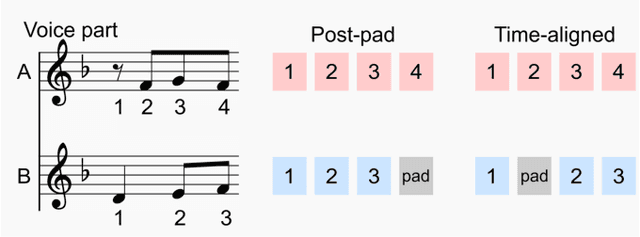
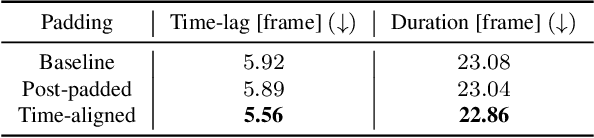
We propose a singing voice synthesis (SVS) method for a more unified ensemble singing voice by modeling interactions between singers. Most existing SVS methods aim to synthesize a solo voice, and do not consider interactions between singers, i.e., adjusting one's own voice to the others' voices. Since the production of ensemble voices from solo singing voices ignores the interactions, it can degrade the unity of the vocal ensemble. Therefore, we propose a SVS that reproduces the interactions. It is based on an architecture that uses musical scores of multiple voice parts, and loss functions that simulate the interactions' effect to acoustic features. Experimental results show that our methods improve the unity of the vocal ensemble.
The T05 System for The VoiceMOS Challenge 2024: Transfer Learning from Deep Image Classifier to Naturalness MOS Prediction of High-Quality Synthetic Speech
Sep 14, 2024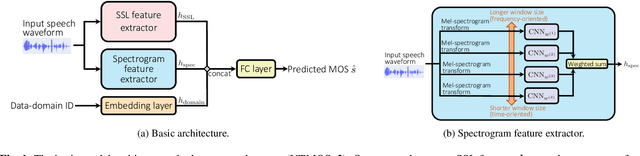
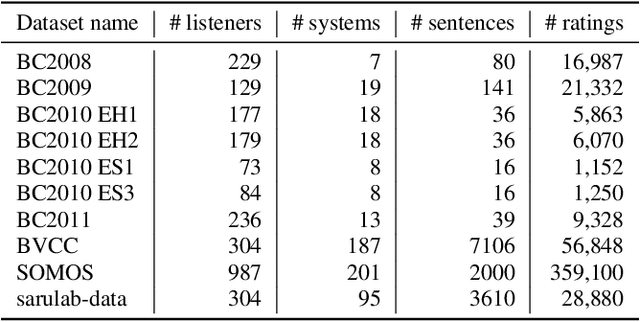
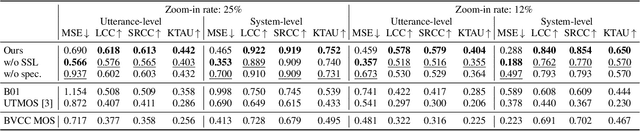

We present our system (denoted as T05) for the VoiceMOS Challenge (VMC) 2024. Our system was designed for the VMC 2024 Track 1, which focused on the accurate prediction of naturalness mean opinion score (MOS) for high-quality synthetic speech. In addition to a pretrained self-supervised learning (SSL)-based speech feature extractor, our system incorporates a pretrained image feature extractor to capture the difference of synthetic speech observed in speech spectrograms. We first separately train two MOS predictors that use either of an SSL-based or spectrogram-based feature. Then, we fine-tune the two predictors for better MOS prediction using the fusion of two extracted features. In the VMC 2024 Track 1, our T05 system achieved first place in 7 out of 16 evaluation metrics and second place in the remaining 9 metrics, with a significant difference compared to those ranked third and below. We also report the results of our ablation study to investigate essential factors of our system.
Cross-Dialect Text-To-Speech in Pitch-Accent Language Incorporating Multi-Dialect Phoneme-Level BERT
Sep 11, 2024We explore cross-dialect text-to-speech (CD-TTS), a task to synthesize learned speakers' voices in non-native dialects, especially in pitch-accent languages. CD-TTS is important for developing voice agents that naturally communicate with people across regions. We present a novel TTS model comprising three sub-modules to perform competitively at this task. We first train a backbone TTS model to synthesize dialect speech from a text conditioned on phoneme-level accent latent variables (ALVs) extracted from speech by a reference encoder. Then, we train an ALV predictor to predict ALVs tailored to a target dialect from input text leveraging our novel multi-dialect phoneme-level BERT. We conduct multi-dialect TTS experiments and evaluate the effectiveness of our model by comparing it with a baseline derived from conventional dialect TTS methods. The results show that our model improves the dialectal naturalness of synthetic speech in CD-TTS.